Draw a Triangle From Memory
Three straight lines and three corners, on screen for a couple of seconds, then gone. You draw it back from memory onto an empty canvas, and your attempt is scored against the target and laid over it afterwards, so you can see exactly where it went.
It looks like the easiest shape in the library, and it is the one with the least to hide behind. The target is an equilateral triangle: three sides of the same length, three 60° corners, a perfectly level base and an apex straight above the middle of it. Freehand, each of those can slip - the base tilts, the apex drifts off the centre line, one side comes out longer than the other - and the edges bow slightly as a hand drawing at speed curves where it means to go straight.
It is 59% of the canvas wide and 51% tall, so its height is about 0.87 of its width. With no features to carry the drawing, three straight lines either meet where they should or they do not.
This is a practice round: played and scored for real, and it changes nothing in your game - no coins, no best score, no unlocks - so you can take it as often as you like, whether or not you have reached the triangle in the Shape Challenge.
Three equal sides, three chances to be wrong
The triangle is one closed line, and the scorer spreads its 128 comparison points evenly along it: about 43 for each of the three sides, 33% apiece. Where you start, and which way round you go, are not scored - every starting point is tried in both directions - so the order of the corners is yours.
What is scored is where each side ends up. Shape match can be no better than the worst-matching tenth of the outline allows, so one side that has strayed does more damage than a slight wobble spread over all three - which is what an apex drifting off the centre line does.
| Part | Share of the line | Comparison points |
|---|---|---|
| Base | 33% | 43 |
| Left side | 33% | 43 |
| Right side | 33% | 43 |
Apex, tilt or proportions: what each slip costs
The same hand, with nothing wrong, scores 91. Let the apex drift 8% of the triangle's width off the centre line and it scores 77: shape match falls from 88 to 68. Nothing is missing and the size is unchanged - coverage is 99, scale 98 - but the two sides are now different lengths.
Tilt the base by 7°, holding the apex in place, and the total is 84. Draw the triangle 30% too tall for its width and it is 79, with scale down to 86 as the drawing outgrows the target's size.
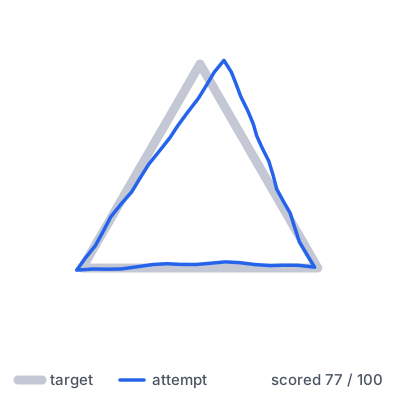
| Attempt | Total | Shape | Coverage | Smoothness | Scale |
|---|---|---|---|---|---|
| The same hand, no mistake | 91 | 88 | 99 | 94 | 98 |
| Apex drifts 8% of the width off the centre line | 77 | 68 | 99 | 94 | 98 |
| Base tilts 7° with the apex held in place | 84 | 78 | 99 | 94 | 96 |
| Drawn 30% too tall for its width | 79 | 75 | 99 | 94 | 86 |
Three drills for the triangle
- Level base first. Draw the base on its own, left to right, as a level line about 59% of the canvas wide - the target's base sits about two-thirds of the way down the canvas - and only then go up to the apex.
- Apex over the midpoint. The apex sits exactly above the middle of the base, and about 0.87 of the base's length above it. Mark the midpoint in your head before you leave the base.
- Compare the two sides. Judge the two sloping sides against each other, not against the base: they should be the same length and meet the base at the same 60° angle. A side that is visibly longer means the apex has drifted.
Questions people ask
- What happens after the shape disappears?
- You draw on a blank canvas with no guide underneath, in one attempt. The outline comes back afterwards, laid over your drawing so you can see the difference.
- How is my score worked out?
- Shape match, coverage, smoothness and scale, combined into one score shown with a star rating and a tip. Shape match counts for the most, at 70%.
- Can I play with other people?
- Two ways. 2 Players passes one device back and forth, alternating who draws first each round. Multiplayer opens a live room for 2–8 players over 5, 10 or 15 rounds, joined with a six-character code.
- How many shapes are there?
- 276 shapes across 12 categories, from geometry and letters to animals, food and fantasy.
- Draw a perfect circle
- Draw a lightning bolt from memory
- All drawing challenges
- How the score is worked out
- CYDI home
Browse Every Shape Challenge →
Enjoy CYDI on Android - get CYDI on Google Play
How to play · About · Contact · Privacy · Terms
© 2026 Lior Rubinovich. All rights reserved.