Draw a Lightning Bolt From Memory
The bolt is on screen for a couple of seconds, then it is gone and the canvas is empty. You draw it back from memory - one unbroken line, all straight edges, no curves anywhere - and your attempt is scored against the target and laid over it afterwards, so you can see exactly where the angles went.
A lightning bolt is the shape everyone thinks they know, which is exactly why the details slip. It is one closed outline of six corners and no curves: a top tip, a bottom tip, and two short horizontal steps between them, the right one a little higher than the left. It is twice as tall as it is wide - 80% of the canvas high, 40% wide - and nothing about it is symmetrical.
What gives it away is how the edges lean. Measured from vertical, the long edge running up to the right from the bottom tip leans about 36°, while the edge on the same side running down from the top tip is almost upright, at about 9°. On the left, the upper edge leans about 32° and the lower one about 18°. The easy slip is to even all of that out into a tidy Z, with the bottom tip straight under the top one; adding an extra kink is the other.
This is a practice round: played and scored for real, and it changes nothing in your game - no coins, no best score, no unlocks - so you can take it as often as you like, whether or not you have reached Symbols in the Shape Challenge.
Where the line is, and where the scorer looks
The bolt is one line of six straight edges, and the scorer spreads its 128 comparison points along it by length. The lower arm - the two edges that meet at the bottom tip - holds 46% of them (59 points), the upper arm 36%, and the two short horizontal steps only 17% between them.
A bolt has no small features for a near-miss to hide in: a tip that is out of place moves a whole arm, and shape match is held to the worst-matching tenth of the outline. So where the two tips sit matters more than how the steps are drawn, which is what the example below measures.
| Part | Share of the line | Comparison points |
|---|---|---|
| Upper arm - the two edges that meet at the top tip | 36% | 46 |
| The two horizontal steps | 17% | 22 |
| Lower arm - the two edges that meet at the bottom tip | 46% | 59 |
The tips against the steps
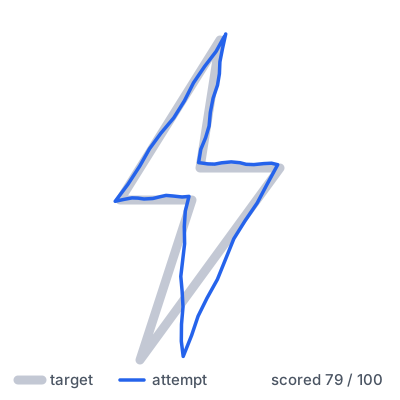
With nothing wrong, the same hand scores 93. Draw the bottom tip halfway under the top tip - a drift of a tenth of the canvas, enough to make the bolt look straighter - and it scores 79: shape match falls from 92 to 72.
The details that look important cost less. Both steps at the same height: 87. An extra kink in the long lower edge: 89. Each costs less than half of what one drifting tip costs.
| Attempt | Total | Shape | Coverage | Smoothness | Scale |
|---|---|---|---|---|---|
| The same hand, no mistake | 93 | 92 | 100 | 90 | 98 |
| Bottom tip drawn halfway under the top tip | 79 | 72 | 97 | 89 | 99 |
| The two steps drawn at the same height | 87 | 82 | 99 | 89 | 99 |
| An extra kink added to the long lower edge | 89 | 85 | 99 | 87 | 98 |
Three drills for the bolt
- Tips first. Place the two tips before you draw anything else: the top tip about 55% of the way across the canvas and 10% down, the bottom tip at 35% across and 90% down. The bottom tip sits 20% of the canvas to the left of the top one - half the bolt's width.
- Two steps, two heights. The steps are the one place the bolt runs level: the left one about 50% of the way down the canvas, the right one about 8% higher, at 42%, and nearly the same length (18% and 20% of the canvas). Keep the right step higher than the left.
- Count to six. Name the corners as you draw: top, out left, in, bottom, out right, in - six, and then back to the top. A seventh means you have added a kink.
Questions people ask
- What happens after the shape disappears?
- You draw on a blank canvas with no guide underneath, in one attempt. The outline comes back afterwards, laid over your drawing so you can see the difference.
- How is my score worked out?
- Shape match, coverage, smoothness and scale, combined into one score shown with a star rating and a tip. Shape match counts for the most, at 70%.
- Can I play with other people?
- Two ways. 2 Players passes one device back and forth, alternating who draws first each round. Multiplayer opens a live room for 2–8 players over 5, 10 or 15 rounds, joined with a six-character code.
- How many shapes are there?
- 276 shapes across 12 categories, from geometry and letters to animals, food and fantasy.
- Draw a perfect star
- Draw a snail from memory
- All drawing challenges
- How the score is worked out
- CYDI home
Browse Every Shape Challenge →
Enjoy CYDI on Android - get CYDI on Google Play
How to play · About · Contact · Privacy · Terms
© 2026 Lior Rubinovich. All rights reserved.