Draw a Perfect Circle
Drawing a perfect circle freehand is famously hard. There are no straight edges to anchor against and no corners to aim for - just one continuous curve that has to come back and meet exactly where it started.
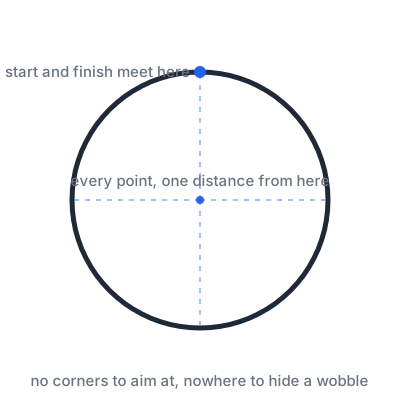
Try it here. The target circle is shown for a few seconds, then you draw yours on the blank canvas and get an instant score out of 100, with your attempt overlaid on the target so you can see precisely where the curve went wide, flat or lumpy. A wobbly line costs you smoothness, an oval costs you shape match, and stopping short of the join costs you coverage.
Two things decide it. Every point of a circle sits the same distance from its centre, so any stretch into an oval shows up immediately in shape match - which is 70% of the score, far more than the smoothness a shaky line costs you. And the line has to come back to where it started: the join is the one place a circle can visibly fail to close.
Draw it big. Size is the other 20%, and it works as a ceiling as well as a component - up to about 15% off costs nothing, but past that every further 1% of size error takes a point off the highest total the round can reach. A neat little circle in the corner of the canvas cannot score what the same circle drawn full size would.
The last few percent are the hard part: the gap between a good circle and a great one is almost entirely hand steadiness and pace. Retry as often as you like, since only your best score is kept, and move on to tougher targets whenever you are ready.
How the scorer reads a circle
A circle is one closed line, so all 128 comparison points land on it - there is no small detail to hide behind and none to rescue you. Because it is closed, the scorer also tries every possible starting point, in both directions, before it compares: where you begin and which way you go round never cost anything.
What does cost you is the stretch of line that strays furthest. After finding the best alignment, the scorer checks the worst-matching tenth of the outline, and shape match can be no better than that tenth allows. One flat side or one unfinished end therefore counts for more than an even wobble spread all the way round.
| Part | Share of the line | Comparison points |
|---|---|---|
| The one closed line | 100% | 128 |
What two common circle mistakes cost
The same freehand circle, drawn with one slight, even wobble, scores 92. Stop 12% short of the join and it scores 66: on paper the gap only costs coverage, but the unfinished end is exactly the worst tenth the contour check looks at, so shape match falls from 89 to 54.
Draw the same good circle at 58% of the size and shape match does not move - it is still 89 - yet the total falls to 73. Size beyond the 15% tolerance lowers the ceiling the whole score is held under, however round the circle is.
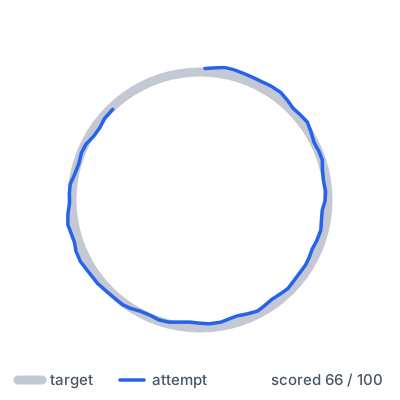
| Attempt | Total | Shape | Coverage | Smoothness | Scale |
|---|---|---|---|---|---|
| The same hand, no mistake | 92 | 89 | 100 | 92 | 99 |
| Stops 12% short of the join | 66 | 54 | 87 | 93 | 100 |
| A good circle, drawn at 58% of the size | 73 | 89 | 100 | 92 | 58 |
Three drills for a rounder circle
- Four compass points. Before you draw, pick a centre and picture four marks - top, bottom, left and right - all the same distance out. Draw through them in one pass. Every point of a circle is that one distance from the centre, so four checkpoints catch an oval before it forms.
- Finish on the start. Draw ten circles and watch only the join: slow down over the last quarter and land exactly on your starting point, without stopping short or overshooting. As the example shows, an unclosed end costs more than any wobble.
- Fill two-thirds of the canvas. The target's diameter is 64% of the canvas width - nearly two-thirds. Practise at that size: the same circle drawn half as wide cannot score what it would full size.
Questions people ask
- What happens after the shape disappears?
- You draw on a blank canvas with no guide underneath, in one attempt. The outline comes back afterwards, laid over your drawing so you can see the difference.
- How is my score worked out?
- Shape match, coverage, smoothness and scale, combined into one score shown with a star rating and a tip. Shape match counts for the most, at 70%.
- Can I play with other people?
- Two ways. 2 Players passes one device back and forth, alternating who draws first each round. Multiplayer opens a live room for 2–8 players over 5, 10 or 15 rounds, joined with a six-character code.
- How many shapes are there?
- 276 shapes across 12 categories, from geometry and letters to animals, food and fantasy.
Play More Drawing Challenges →
Enjoy CYDI on Android - get CYDI on Google Play
How to play · About · Contact · Privacy · Terms
© 2026 Lior Rubinovich. All rights reserved.