How to Play CYDI
CYDI is a drawing accuracy game. It is not a draw-and-guess game: nobody has to work out what you drew, and there is no word to describe. You are shown a shape, it is taken away, you redraw it from memory, and the game measures how close you got.
It plays in a browser with a mouse, a trackpad or a finger, and there is no account to create - your progress and best scores live in your own browser storage.
A round: See, Remember, Draw, Score
- SeeThe target shape appears on the canvas for 2 seconds (3 seconds on your very first round, which is coached and shows a countdown). That is your whole look at it, and it is long enough to take in a shape but not to measure one - which is the game.
- RememberThe target is then cleared completely. There is no faded outline left behind and nothing to trace over: what you draw comes out of your head, not off the screen.
- DrawYou redraw the shape freehand on the empty canvas. Shapes made of separate parts - a stem and a leaf, the dot on an exclamation mark - are drawn as separate strokes, and the gaps between strokes are not treated as lines you drew.
- ScoreYour attempt is compared against the target and scored out of 100, with a star rating and a short verdict. Then your drawing is laid over the target so you can see exactly where the line went, which is usually more useful than the number.
How the score is worked out
Both the target and your attempt are resampled to 128 evenly spaced points and compared point for point. Four things are measured, and they do not count equally - the shape itself is most of the score:
| Component | Share | What it measures |
|---|---|---|
| Shape match | 70% | How closely your outline follows the target's form, point by point. This is the score. |
| Scale | 20% | Whether you drew it the right size, rather than much smaller or larger than the target. |
| Coverage | 5% | Whether you drew the whole shape, or stopped short and left part of it undrawn. |
| Smoothness | 5% | Whether the line is steady, or drawn in short nervous strokes that zig-zag along the way. |
Two rules in the comparison are worth knowing, because they decide scores that otherwise look unfair:
- Where you start and which way you go round do not matter. Before comparing, the game tries every one of the 128 possible starting points, in both directions, and keeps the best alignment. Drawing a circle anticlockwise from the bottom scores exactly the same as clockwise from the top.
- Size has a ceiling, not just a penalty. Up to about 15% off the target's size costs you nothing. Past that, every further 1% of size error takes 1 point off the highest total the round can reach - so a beautifully shaped drawing made at a third of the size cannot sneak into the 80s on shape alone.
A worked example
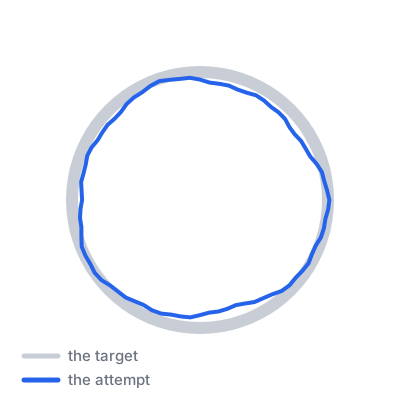
This attempt is a circle drawn a little small, a little wider than it is tall, with a slow waver in the line. Scored by the game, it comes out like this:
| Component | Score |
|---|---|
| Shape match | 83 / 100 |
| Scale | 96 / 100 |
| Coverage | 98 / 100 |
| Smoothness | 91 / 100 |
| Total | 86 / 100 - “Excellent” |
It is a good illustration of where a round is really won. Coverage and smoothness are nearly full marks and together they are worth only 10% of the total. The 83 for shape match is what holds this round below a top score, because the outline is an oval and shape match is most of the marks. Steadying your hand is worth far less than getting the form right.
Stars, passing and difficulty
| Score | Stars |
|---|---|
| 50 and above | ★ |
| 60 and above | ★★ |
| 70 and above | ★★★ |
| 80 and above | ★★★★ |
| 90 and above | ★★★★★ |
The verdict beside the score comes from the same scale: “Incredible” from 95, “Excellent” from 85, “Nice work” from 70, “Getting close” from 50.
Whether a round passes - which is what unlocks the next shape - depends on the difficulty you chose in Settings. It is the one setting that changes the bar, and it starts on Skilled:
| Difficulty | Score needed to pass |
|---|---|
| Beginner | 50 |
| Intermediate | 60 |
| Skilled (default) | 70 |
| Expert | 80 |
| Master | 90 |
Only your best score on a shape is kept, so retrying costs you nothing - a worse attempt never replaces a better one.
Coins and what they are for
Finishing a shape pays coins according to the stars you earned:
| Stars | Coins |
|---|---|
| ★ | 10 |
| ★★ | 20 |
| ★★★ | 35 |
| ★★★★ | 55 |
| ★★★★★ | 80 |
There are other ways to earn them - a free Daily Chest worth 50-150 coins, the Daily Challenge prizes below, and one-off rewards for finishing special and collectible challenges. Coins buy things inside the game: unlocking a new shape category costs 1,000 coins, and the shop sells ink colours, pen skins and chests.
CYDI Coins are in-game points only. They cannot be bought with money, and they have no cash value and cannot be exchanged or redeemed for anything outside the game.
The Daily Challenge
One shape a day, and it is the same shape for every player in the world - there is a single daily episode, not a per-player one, which is what makes the scores comparable. It rolls over at midnight Israel time (Asia/Jerusalem), and once an episode's shape has been drawn it is fixed for that day.
Your score goes on a public leaderboard for that episode, under whatever display name you have set (the default is “Anonymous Player”, and you can leave it that way). Only the number is sent - your drawing itself never leaves your device in this mode. When an episode ends, the top three players are paid 1,000, 500 and 250 coins, waiting to be claimed the next time they open the game.
2 Players on one phone
Pass-and-play, for one device and two people. You hand the phone over between turns and the game tells you whose turn it is.
- Both players get the same shape each round: it shows for 3 seconds, then you have 20 seconds to redraw it.
- Neither drawing nor score is revealed until you have both finished, so the second player has nothing to copy and no target score to play against.
- The round then opens up: the target, both attempts laid over it, and the accuracy and speed behind each score.
- Whoever goes first alternates every round, and the highest total after the last round wins.
2 Players does not require a multiplayer connection while you play, and it works the same in the browser and in the Android app.
Play Together (online multiplayer)
2 to 8 players, each on their own device, all drawing the same shape at the same time. One person creates a room and shares a link, a QR code, or the 6-character room code; everyone else joins in a browser. No app and no account.
- Each round the shape shows for 3 seconds, then everyone has 20 seconds to draw.
- Scoring runs on the server, not on any player's device, so every drawing in the room is judged by the same code under the same rules. Finishing faster earns a speed bonus on top of accuracy.
- A game can be 5, 10, or 15 rounds; scores add up and the highest total wins.
- If your connection drops you keep your seat and your score, and rejoin wherever the game has got to.
- Rooms are temporary: one is deleted automatically once nobody has been connected to it for 30 minutes, and the nicknames and scores go with it.
What there is to play
The main Shape Challenge holds 276 shapes across 12 categories. The first category is open from the start; each shape you pass unlocks the next one in its category, and further categories are unlocked with coins (1,000 each).
| Category | Shapes |
|---|---|
| Geometric Shapes | 50 |
| Symbols | 20 |
| English Alphabet | 26 |
| Home & Objects | 20 |
| Nature | 20 |
| Food | 20 |
| Sports | 20 |
| Transportation | 20 |
| Animals | 20 |
| Calligraphy | 20 |
| Fantasy | 20 |
| Universal Symbols | 20 |
You can browse the shape categories, take the accuracy test, or start with the three shapes most people try first: the circle, the five-point star and the heart.
Why did I score that?
The four components make most surprising scores easy to diagnose:
- “It looked right but scored badly.” Almost always shape match - the proportions drifted. Check the overlay: a circle that came out as an oval, or a star with one short arm, is a shape-match problem, and shape match is most of the score.
- “My drawing was neat and small.” Size. Neatness is worth a few points; drawing at half the target's size runs into the ceiling and caps the round no matter how clean the line is. Use the canvas.
- “I ran out of room and stopped.” Coverage. An unfinished outline scores as an unfinished outline, though it costs less than most people expect.
- “My hand shakes.” Smoothness, and it is the smallest term in the score. A shaky line that follows the right form still scores well; a steady line in the wrong form does not.
- “I started in a different place.” Not a factor - starting point and direction are aligned away before anything is compared.