Draw a Cat From Memory
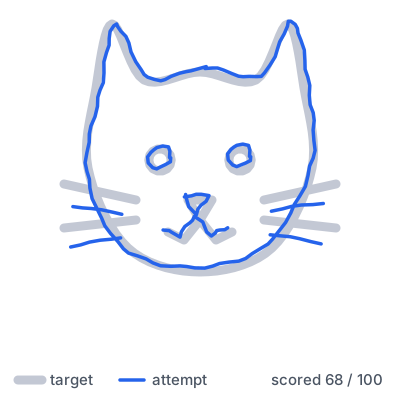
The cat is on screen for a couple of seconds. Then it is gone, the canvas clears, and you draw it back from memory - the head, the two ears, the eyes and the whiskers. Your line is scored against the target and laid over it afterwards, so you can see which part of it you remembered and which part you invented.
A face is harder to redraw than it looks, because the features have to land in the right place relative to each other, not just be present. It is easy to get a good head and then find the ears too small and the whiskers too low.
The cat's ears are not separate shapes: they are built into the head's outline. The line rises to a point on each side and drops into a notch at the crown between them, and each tip stands about a fifth of the head's height above that notch. The four whiskers are straight lines that start inside the face and run out past the outline - the upper pair angled up as they leave, the lower pair angled slightly down.
This is a practice round: played and scored for real, and it changes nothing in your game - no coins, no best score, no unlocks - so you can take it as often as you like, whether or not you have reached Animals in the Shape Challenge.
Whiskers are a fifth of the cat
The cat is nine separate parts. The head outline, with both ear points, carries 60% of the 128 comparison points. The four whiskers - plain straight lines, the plainest part of the drawing - carry 20% (25 points): twice what the two eyes get (10%) and more than the nose and W-shaped mouth together (11%).
Four short lines are easy to treat as decoration. To the scorer they are a fifth of the drawing, which is why the next section prices what happens when they are drawn short, drawn low, or left out.
| Part | Share of the line | Comparison points |
|---|---|---|
| Head outline, with the two ear points | 60% | 77 |
| Eyes | 10% | 12 |
| Nose and W-shaped mouth | 11% | 14 |
| The four whiskers | 20% | 25 |
What whiskers and ear points cost
The same hand, with nothing wrong, scores 88. Draw the whiskers 30% shorter and a little lower on the cheeks and it scores 68: shape match falls from 85 to 57. Four lines that look like detail cost 20 points.
Ear points drawn 60% shorter - stubby bumps instead of points - cost 12, for a total of 76. Leave the whiskers out altogether and it is 61, with coverage down to 74, because a fifth of the line is simply missing.
| Attempt | Total | Shape | Coverage | Smoothness | Scale |
|---|---|---|---|---|---|
| The same hand, no mistake | 88 | 85 | 100 | 71 | 100 |
| Whiskers drawn 30% shorter and lower on the cheeks | 68 | 57 | 97 | 71 | 96 |
| Ear points drawn 60% shorter | 76 | 70 | 95 | 73 | 94 |
| The whiskers left out | 61 | 50 | 74 | 71 | 92 |
Three drills for the cat
- Whiskers cross the outline. Draw the head first, then start each whisker inside the face and run it out past the outline. Each is about a third as long as the head is wide, and its tip ends about a tenth of the head's width outside the outline.
- Up above, down below. The upper whisker on each side leaves the face angled up by about 12°; the lower one angles down by about 6° - the lower pair is the flatter of the two.
- Climb to the tip, drop to the notch. Draw the crown as a climb to a point on each side with a notch between them. The two tips are about three-quarters of the head's width apart, and each stands about a fifth of the head's height above the notch.
Questions people ask
- What happens after the shape disappears?
- You draw on a blank canvas with no guide underneath, in one attempt. The outline comes back afterwards, laid over your drawing so you can see the difference.
- How is my score worked out?
- Shape match, coverage, smoothness and scale, combined into one score shown with a star rating and a tip. Shape match counts for the most, at 70%.
- Can I play with other people?
- Two ways. 2 Players passes one device back and forth, alternating who draws first each round. Multiplayer opens a live room for 2–8 players over 5, 10 or 15 rounds, joined with a six-character code.
- How many shapes are there?
- 276 shapes across 12 categories, from geometry and letters to animals, food and fantasy.
- Draw a dog from memory
- Draw a perfect circle
- All drawing challenges
- How the score is worked out
- CYDI home
Browse Every Shape Challenge →
Enjoy CYDI on Android - get CYDI on Google Play
How to play · About · Contact · Privacy · Terms
© 2026 Lior Rubinovich. All rights reserved.