Draw a Dog From Memory
Look at the dog for a couple of seconds. It disappears, the canvas clears, and you draw it back from memory - ears, muzzle, eyes and all. The score comes straight after, with your line laid over the target so you can see exactly where your memory drifted.
Drawing from memory is a different problem from tracing. The outline is gone when your hand starts moving, so what you are really redrawing is what you noticed: how far apart the ears sit, how low the muzzle hangs, how wide the head is against its height. It is easy to get the head about right and discover the ears moved.
The target is built from eight separate pieces: a head about as wide as it is tall, two floppy ears, two eyes, a small round nose, a short muzzle line and a two-stroke mouth. The ears are the unusual part. Each is a closed loop that straddles the head's outline - roughly half of it inside the head and half outside - so the ears stick out past the sides of the face instead of sitting on top of it.
The round here is a practice round. It is played and scored exactly like the real thing, and it changes nothing in your game - no coins, no unlocks, no best score - so you can take it as many times as you like before you go and play the rest.
Why the ears outweigh the eyes
The dog is eight separate parts, and the scorer spreads its 128 comparison points along the line by length. The head outline carries 44% of them (56 points). The two floppy ears carry 39% - 49 points, nearly as many as the head itself. The eyes get 8%, and the nose, muzzle line and mouth together 9%: the features that make it a dog's face are the smallest part of the score.
Stroke order is not scored, so draw the parts in whatever order suits you. What is scored is that every part is there and in the right place, which is what the next section prices.
| Part | Share of the line | Comparison points |
|---|---|---|
| Head outline | 44% | 56 |
| Floppy ears | 39% | 49 |
| Eyes | 8% | 10 |
| Nose, muzzle line and mouth | 9% | 12 |
Ears, a misplaced muzzle, a missing mouth
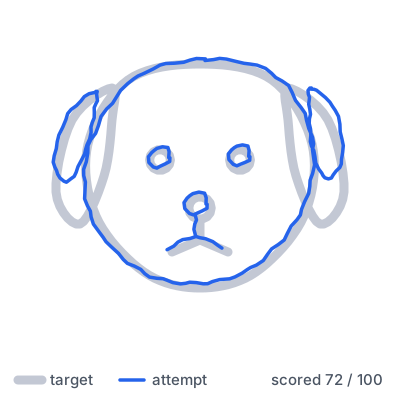
The same hand, with nothing wrong, scores 88. Draw both ears 35% smaller and set higher on the head and the dog scores 72: shape match falls from 85 to 62, while coverage only slips from 99 to 94, because nearly all the line is still there, just not where the ears belong.
Slide the nose, muzzle line and mouth up until they crowd the eyes and the score is 81 - a smaller loss, from a group that is only 9% of the line. Leave the mouth out altogether and it falls to 70, a bigger loss than moving the whole muzzle. A misplaced part still lines up roughly with the target; a missing one gives the target's points nothing to line up with, so even a crude mouth is worth drawing.
| Attempt | Total | Shape | Coverage | Smoothness | Scale |
|---|---|---|---|---|---|
| The same hand, no mistake | 88 | 85 | 99 | 71 | 99 |
| Ears 35% smaller and set higher on the head | 72 | 62 | 94 | 70 | 99 |
| Nose, muzzle line and mouth drawn higher, close to the eyes | 81 | 75 | 100 | 71 | 99 |
| The mouth left out | 70 | 60 | 97 | 72 | 99 |
Three drills for the dog
- Ears astride the outline. Draw the head, then each ear so that it straddles the outline: about half its width inside the head, half outside. Each ear starts just below the top of the head and hangs to about 70% of the way down, so it is around three-fifths as tall as the head.
- Eyes at 43%. Put the eye centres about 43% of the way down the head - above the middle, not on it - and about a third of the head's width apart.
- One stack under the eyes. Everything below the eyes sits on the centre line: the nose about 64% of the way down the head, a short line dropping from it, then a mouth no wider than about a quarter of the head.
Questions people ask
- What happens after the shape disappears?
- You draw on a blank canvas with no guide underneath, in one attempt. The outline comes back afterwards, laid over your drawing so you can see the difference.
- How is my score worked out?
- Shape match, coverage, smoothness and scale, combined into one score shown with a star rating and a tip. Shape match counts for the most, at 70%.
- Can I play with other people?
- Two ways. 2 Players passes one device back and forth, alternating who draws first each round. Multiplayer opens a live room for 2–8 players over 5, 10 or 15 rounds, joined with a six-character code.
- How many shapes are there?
- 276 shapes across 12 categories, from geometry and letters to animals, food and fantasy.
Browse Every Shape Challenge →
Enjoy CYDI on Android - get CYDI on Google Play
How to play · About · Contact · Privacy · Terms
© 2026 Lior Rubinovich. All rights reserved.