Draw a Bear From Memory
The bear is on screen for a couple of seconds, then it is gone and the canvas is empty. You draw it back from memory - the round head, the two ears on top of it, the eyes, and the muzzle with its nose and mouth. Your line is scored against the target and laid over it afterwards, so you can see which parts you kept and which ones drifted.
A bear is mostly one round head, which sounds easy until the details have to land on it. The ears are the giveaway: they sit high on the outline rather than beside it, and in memory they tend to slide outwards and shrink. The muzzle is the other one - it belongs low on the face, and almost everyone draws it closer to the eyes than it really is.
This is a practice round: played and scored for real, and it changes nothing in your game - no coins, no best score, no unlocks - so you can take it as often as you like, whether or not you have reached Animals in the Shape Challenge.
How the scorer reads a bear
The bear is eight separate parts, and the scorer gives each a share of the 128 comparison points in proportion to how much line it has. The head outline carries 44%. The two ears are 26% between them - more than the muzzle, nose and mouth together (23%) - and the eyes only 7%.
Ears that are a quarter of the drawing decide a lot. When they drift, they become the worst-matching tenth of the outline, and the scorer holds the whole shape-match score to that tenth - however good the face below them is.
| Part | Share of the line | Comparison points |
|---|---|---|
| Head outline | 44% | 56 |
| Ears | 26% | 33 |
| Muzzle, nose and mouth | 23% | 30 |
| Eyes | 7% | 9 |
What drifting ears cost
Drawn with a slight, even wobble and nothing else wrong, the bear scores 88. Draw the ears 30% smaller and let them slide outwards and down the sides of the head - the way memory tends to move them - and the same bear scores 64. Shape match falls from 86 to 51, while coverage stays at 99: all the line is there, just not where the ears belong.
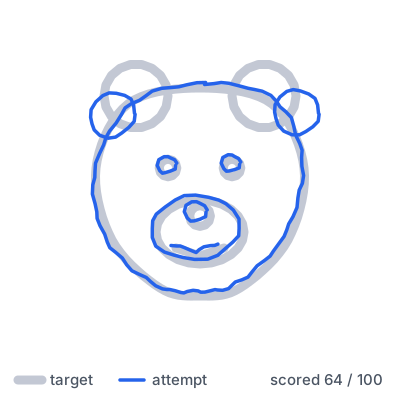
| Attempt | Total | Shape | Coverage | Smoothness | Scale |
|---|---|---|---|---|---|
| The same hand, no mistake | 88 | 86 | 100 | 68 | 99 |
| Ears smaller, slid outwards and down the sides | 64 | 51 | 99 | 68 | 100 |
Three drills for the bear
- Ears on the rim. Draw the head, then centre each ear right on its outline, about a fifth of the head's width in from each side. Each ear is nearly a third as wide as the head - bigger than it feels.
- Muzzle low. Draw the muzzle as an oval about 40% of the head's width, centred roughly 70% of the way down. Check it against the chin, not against the eyes.
- Leave the gap. Between the eye line and the top of the muzzle, the target leaves about a sixth of the head's height. Draw the eyes, then deliberately leave that gap before starting the muzzle.
Questions people ask
- What happens after the shape disappears?
- You draw on a blank canvas with no guide underneath, in one attempt. The outline comes back afterwards, laid over your drawing so you can see the difference.
- How is my score worked out?
- Shape match, coverage, smoothness and scale, combined into one score shown with a star rating and a tip. Shape match counts for the most, at 70%.
- Can I play with other people?
- Two ways. 2 Players passes one device back and forth, alternating who draws first each round. Multiplayer opens a live room for 2–8 players over 5, 10 or 15 rounds, joined with a six-character code.
- How many shapes are there?
- 276 shapes across 12 categories, from geometry and letters to animals, food and fantasy.
- Draw a cat from memory
- Draw a dog from memory
- All drawing challenges
- How the score is worked out
- CYDI home
Browse Every Shape Challenge →
Enjoy CYDI on Android - get CYDI on Google Play
How to play · About · Contact · Privacy · Terms
© 2026 Lior Rubinovich. All rights reserved.