Draw a Perfect Star
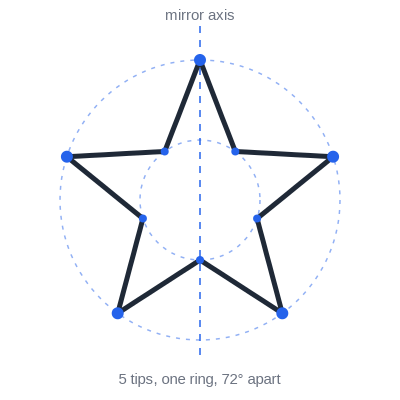
A star punishes a different weakness than a circle does. Nothing here is curved: a five-point star is ten straight edges and ten corners, and the whole shape only reads as a star if all five arms come out the same length, the five tips land the same distance from the centre, and each arm sits 72 degrees around from the last.
Draw yours here and the score tells you where the symmetry broke. Your stroke is measured on shape match (are the arms actually where a star's arms belong?), coverage (all five points closed, not four and a gap), smoothness (straight edges rather than bowed ones) and scale, then laid over the target so a short arm or a drifting tip is impossible to miss.
Freehand stars fail in predictable ways: the first arms come out well and the last one has to stretch or shrink to close the loop, the bottom two legs droop inwards, and the inner corners creep outwards until the star starts to look like a flower. Aiming at the tips before you start - and keeping the inner corners on their own smaller circle - is what turns a five-point scribble into a symmetrical star.
Five arms, a fifth of the line each
The star is one closed line of ten straight edges, and the scorer spreads its 128 comparison points along it by length. The top arm gets 20% of them (26 points), the two upper arms 40% between them and the two lower legs 40% - a fifth each. No arm counts for more than another, so there is no arm to get wrong for free.
Because the outline is closed, the scorer tries every starting point in both directions: begin at any tip and go either way round. What it does not forgive is an arm of the wrong length or a corner on the wrong ring - shape match is held to the worst-matching tenth of the outline, and one stunted arm is a fifth of it.
| Part | Share of the line | Comparison points |
|---|---|---|
| Top arm | 20% | 26 |
| The two upper arms | 40% | 51 |
| The two lower legs | 40% | 51 |
A short arm, a fat star, drooping legs
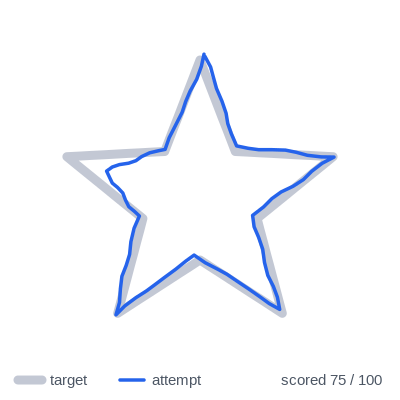
The same hand, with nothing wrong, scores 93. Pull one tip in so that its arm comes out 30% short and the star scores 75: shape match falls from 92 to 67, while the other four arms are drawn exactly as before.
Push all five inner corners 40% further out and the star starts to turn into a flower: 79, with coverage down to 89, because the fatter outline holds more line than the target does. Bring the two bottom tips a tenth of the star's width closer together and the total is 85.
| Attempt | Total | Shape | Coverage | Smoothness | Scale |
|---|---|---|---|---|---|
| The same hand, no mistake | 93 | 92 | 99 | 84 | 99 |
| One arm drawn 30% short | 75 | 67 | 94 | 86 | 94 |
| Inner corners pushed 40% further out | 79 | 72 | 89 | 86 | 99 |
| Bottom two tips drawn a tenth of the star's width closer together | 85 | 81 | 95 | 84 | 99 |
Three drills for a straighter star
- Two rings. Picture two circles around the centre: the tips on one about 70% of the canvas across, the inner corners on a second about 30% across - the inner ring sits 43% of the way out to the tips. Land the corners on that inner ring and the star keeps its points.
- Level pairs. The two side tips sit level with each other, about 39% of the way down the canvas, and the two bottom tips level with each other at about 78%, roughly 41% of the canvas apart. Check each pair against the other before you move on.
- Compare the last arm with the first. Draw the five tips in order, and before the line closes compare the last arm with the first. It is the one that has to meet the start, which makes it the one most likely to have been stretched or squeezed on the way round.
Questions people ask
- What happens after the shape disappears?
- You draw on a blank canvas with no guide underneath, in one attempt. The outline comes back afterwards, laid over your drawing so you can see the difference.
- How is my score worked out?
- Shape match, coverage, smoothness and scale, combined into one score shown with a star rating and a tip. Shape match counts for the most, at 70%.
- Can I play with other people?
- Two ways. 2 Players passes one device back and forth, alternating who draws first each round. Multiplayer opens a live room for 2–8 players over 5, 10 or 15 rounds, joined with a six-character code.
- How many shapes are there?
- 276 shapes across 12 categories, from geometry and letters to animals, food and fantasy.
- Draw a perfect heart
- Draw a perfect circle
- All drawing challenges
- Take the drawing accuracy test
- How the score is worked out
- CYDI home
Browse Every Shape Challenge →
Enjoy CYDI on Android - get CYDI on Google Play
How to play · About · Contact · Privacy · Terms
© 2026 Lior Rubinovich. All rights reserved.